
One testcase, many respondents: a sample-driven test run carries a record that says who is being tested, and the survey asks differently depending on earlier answers. With conditional answers a testcase question gets one or more extra answer columns, each with a condition that decides when it applies.
How a conditional answer works
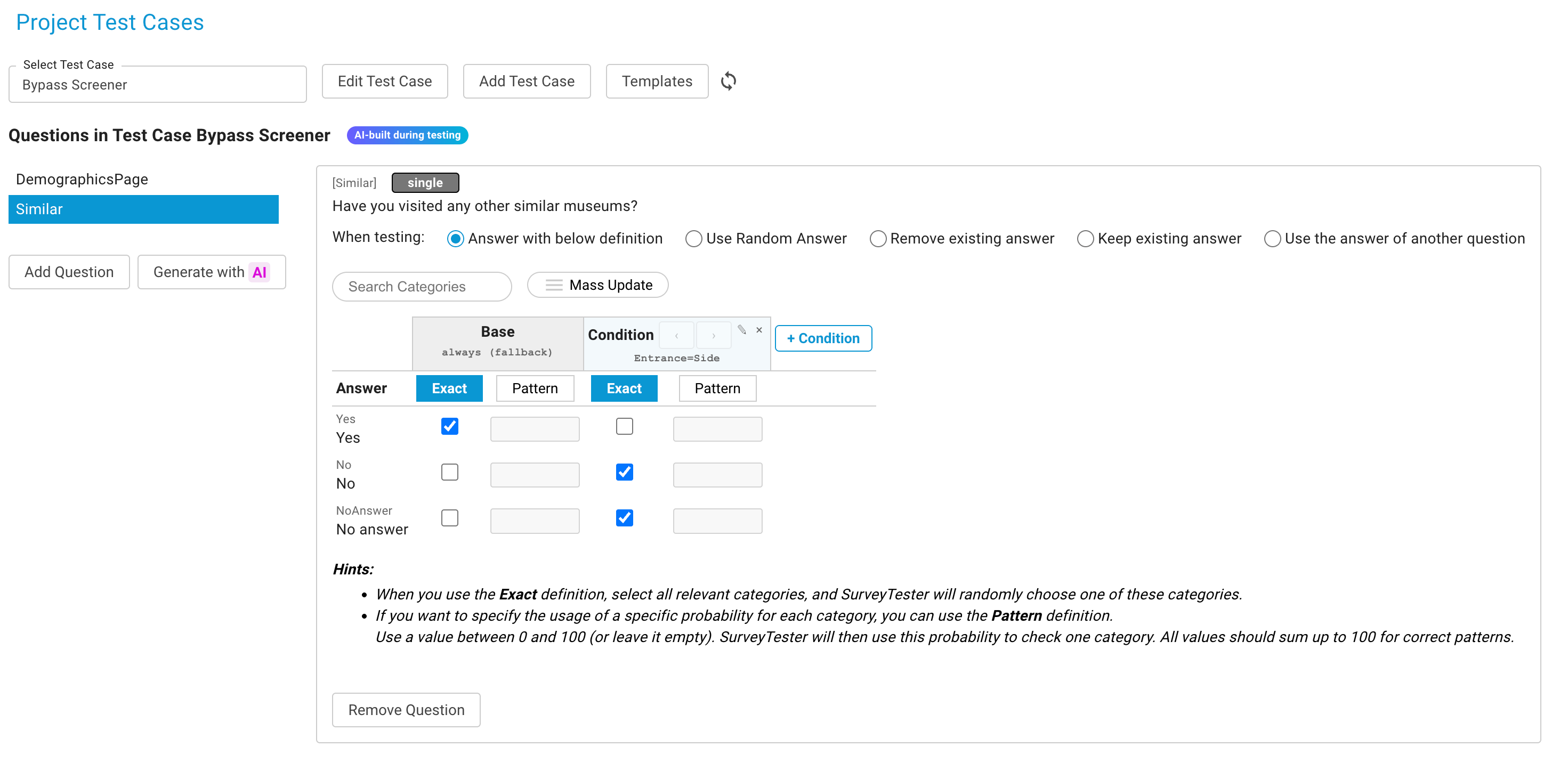
Next to a question's base definition (Exact and Pattern) you add condition columns. Each column carries its own answer definition and a condition built from:
- Sample fields of the record reserved for the test run -
SampleField:country = DE. - Earlier answers of the same run -
Question:q7 = yes.
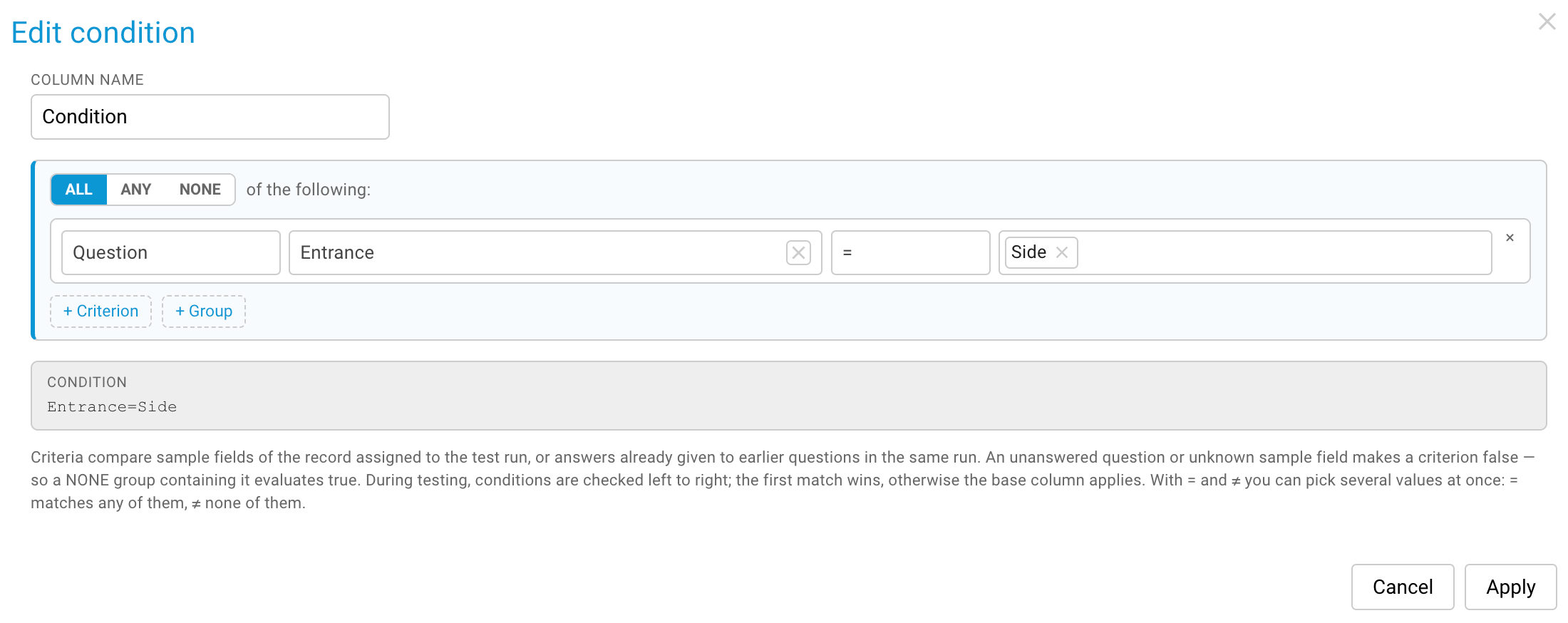
Criteria combine through ALL, ANY and NONE groups, nested as deeply as needed, without typing a parenthesis. Values are picked from what is already known: the values found in your sample records, and for single and multiple response questions the answer categories of the chosen question. The same editor is used for result filters, so the handling is familiar.
During testing the columns are checked from left to right; the first condition that matches supplies the answer, and when none matches the base definition applies. Existing testcases without columns behave exactly as before.
Step by step
- Open the testcase, go to the question and click + Condition.
- Give the column a name and build the condition: choose the source (sample field or question), the field or question, the comparison and the value - add criteria and groups as needed. The dialog shows the resolved condition as text while you build it.
- Fill the column's answer definition like the base one (exact answers, pattern, sum).
- Reorder columns with the arrows when several could match - the first match wins - and remove or edit them at any time.
- Run the testcase: the test run steps show which answer was given.
Notes
- Available for single, multiple, text and numeric questions; grids keep one definition.
- Condition columns travel along when a testcase is duplicated or saved as a template.
- A column whose condition matches but has no answer rows counts as no match; the next column is tried.
- Combine with Use the answer of another question for answers that must stay consistent across questions.
Key takeaway
Conditional answers let one testcase cover several respondent profiles: the condition picks the column, the column answers, and the base definition catches everything else.